Monday, September 12, 2011

MiG-15 details

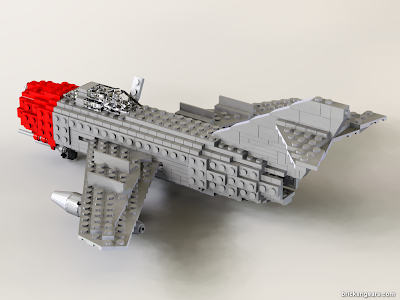
There is a new rendering in the MiG-15 album that shows how the wing is attached to the body:


This render shows the internals of the body, with the outer shell removed. The bricks that are not normally visible are in blue.

The real MiG-15 has a sweep angle of 35 degrees. I approximated that with the typical LEGO Pythagoras layout at 3-4-5 stud offsets. This gives an angle of atan(3/4) = 36.8 degrees.

You can see the triangle at the wing root (large yellow). The studs marked with yellow circles are attached to the body, from the bottom and from the top as well. Even so the structure is far from rigid.

The wing-fences are attached similarly, but the triangle is half the size, at 1.5, 2 and 2.5 stud offsets.

Thursday, June 23, 2011

Silver MiG

I have two piece of news.

First of all, we have the results of the LegoMilitary Build Competition. And I got second prize in the "Warsaw Pact Aircraft" category! I am very happy, I never managed to achieve anything like that in a competition. Mad Physicist was the judge and it was quite competitive... The other finalists are quite impressive too. The An-225 is quite a beast even at 1:100 scale. The Su-9 from John Lamarck is also very nice, for example it has a retractable landing gear. I am proud to be a member of the club.

The second thing is, that of course I was quite curious whether the bricks I have put together on the screen can be actually built together in real life. Executive summary: they can.


In fact the wing was the only place that needed some redesign because the original was incredibly weak. The contour is the same but now it is a little bit stronger. It is not quite like a rock yet, but I am not afraid to hold it in my hands any more. The body is actually quite rigid, it is easy to hold there.

The plane itself is surprisingly heavy. The body consists of many small plates and its interior is quite packed too so that it holds the airplane together. The landing gear is very weak, it can hardly support the vast weight. This can be seen on the photos too. I am still thinking of another design but so far I did not find anything satisfactory.


Also, the rear is quite heavy so I had to put in some extra weight to keep the balance at the front. Inside the plane there are two metal screws that prevent it from "sitting down".

One more thing, the aft of the cabin roof. This is made of a transparent 2x3 slope brick. The last time such a brick was manufactured was in the seventies. I managed to get one, but it is a bit yellowish.


I am happy to have the real plane after all. I have uploaded many photos to the album and of course to Flickr too. One more extra: for hardcore readers I have uploaded the LXF file to this page so that you can try it on Lego Digital Designer.

Sunday, May 15, 2011

MiG-15

Around Easter I have managed to have some rest and even more importantly, away from my other hobbies. As this year's Lego Military Build Competition is currently running I thought I could give it a try.

The announcement of the competition
As I am a big fan of flying things I have tried the "Soviet Cold War Aircraft" category. I chose a MiG-15 as not many LEGO versions exist. The type has served in almost all Warsaw Pact countries including the Hungarian Air Force. Amongst all Soviet types probably this had the most advantage over its Western counterparts. (Does anyone remember Chuck Yeager's Air Combat?)

A Hungarian MiG-15 from the Museum of Hungarian Aviation in Szolnok
Brainstorming has started with the cigar-shaped body. It has a circular cross section with the diameter continuously changing from the front towards the aft. To make it more complicated, the shell gets thin towards the front an the end. The original inspiration was given by the sphere from legohaulic: it seemed that it may be possible to build the cigar from plates, with studs pointing outside.


This is the end result. I tried to build it in the smallest size possible, this corresponds to 1:35 scale approximately. The small size meant some compromises. For example the landing gear is not retractable into the body and the wings.


The model was built with Lego Digital Designerrel in Universe mode). The images were rendered with MegaPOV using Koyan's tutorial. But I already have the bricks underway, I am quite curious if I manage to build it like it is shown on these images.

Until this happens there are more images in the album. Because of the competition I have uploaded the images to Flickr as well.

The competition deadline is May 31st 2011, I am sure we will see lots of great entries.

Sunday, January 9, 2011

New year, new set: 8853 Excavator

And 2011 begun, so Happy New Year. But let's go on to something interesting: today we take a look at an excavator from 1988, more specifically a front loader. I have to admit that even though I was a big Technic fan around that time, I could easily walk past this set. If I deep dive into my memories, I cannot really find anything even though Technicopedia thinks that this set has really existed..


But now I had a chance to learn it much better. I was in a second hand toy fair when I found it for a bit more than 10 USD. I have quickly realized that it has most important parts and all of them are in a good shape, despite coming from the most fragile era of Technic history with toothed connectors and toothed Technic plates. So I decided to grab it.

Datasheet:
  • Number: 8853
  • Theme: Technic, construction
  • Year introduced: 1988
  • Parts: 332 (Peeron)
  • Price: from 30 USD (Bricklink)
Let's take a look at the set. There are no pistons and there is no engine. (Maybe this is why I did not really pay attention around that time). But there is lots of mechanics that can be operated in various ways. The light on the top can steer the rear wheels, like on any normal excavator.


But the really big thing is the bucket operation mechanism that can be moved using the two large steering wheels on the rear. The rearmost wheel lifts the whole bucket mechanism and the bucket while the other one dumps the content of the bucket. It operates with a fairly complicated mechanism with gears and all sorts of arms. The interesting thing is that the two wheels move the bucket independently: the bucket will stay at the same angle unless we operate the dumping wheel.


You have to as really careful with the operation though. The mechanism contains many fragile parts and it clearly feels that if there is any tension in will break very easily (like my own similar aged other sets).


All in all, I think it is a fairly good set. It contains interesting functions and can be played well. For this amount of money I certainly think it was a good buy.

More images in the gallery as usual. If you would like to understand how the mechanisms work the Technicopedia article is very detailed.

Sunday, November 28, 2010

East Block begins - Trabant

I am a big fan of small LEGO cars, especially the creations of Mad Physicst. For a long time I have planned to build cars that were prominent during my childhood. Of course in 1/22 scale. Not surprisingly, these cars are from the Eastern Block: Trabant, Wartburg, "Small Polski", Škoda and the others.

This is the first part of the series, a Trabant 601 from the 80s. I have rendered this on a computer for a start, I hope you like it. I plan to build it from real bricks as well.


The road was slow and is to become even slower. First I got the scale wrong. The real Trabant 601 is 1504 mm wide, it is almost exactly 8 and a half bricks (1504/22/8 = 8.54). The first version I have built in LDD was 8 bricks wide but I have realized that it is too small and the proportions are wrong. To build it one brick wider - well, I could start from scratch. Then I have put it into BrickSmith, I have converted it with L3P so that I can render the image in MegaPOV. And I have spent quite some time playing with the rendering settings, mostly based on Koyan's tutorial.


Well, this is the result, I hope you like it. The next one will most likely be a Škoda 120 because one of my friends is a big fan, or maybe a Small Polski. A few more images in the album.

Thursday, October 21, 2010

Mad Physicist Interview, part II.

And here comes the second part of the interview we started last week. You can read it in Hungarian on lego.blog.hu.

Bricksngears: Do you have to wait often for bricks to arrive before you continue building or do you have everything on stock? How many bricks do you have on stock?
RS: Because I always have a list of things I want to build and because I start planning long before I put bricks together, I usually have all the parts I need by the time I start building. There are also parts that I know I’m likely to use in the future (1x2 and 1x1 plates in just about any colour, for instance) and I try to keep lots of those in stock. I don’t really know how many parts I currently have that aren’t part of MOCs, but we’re probably talking a number on the order of 100,000.

BG: You use many special bricks in your models. Where do you get them from?
RS: I can tell you, but then I’ll have to kill you! Only joking, of course. I buy quite a lot of special stuff from people I know through Brickish. I also always check whether the particular bricklink store I happen to be using for my next project has some other useful and rare parts as well. By accumulating small quantities over time you end up with fairly large numbers of rare stuff.


BG: Do you store all your creations when ready, or do you take some of them apart to reuse bricks?
RS: In the last few years I have built a fair few models specifically for exhibitions or competitions and many of those were dismantled soon after the exhibition or competition ended. Most of my stuff stays together for a long time, however. I get attached to my models and when I have to choose between dismantling them and buying new parts, I tend to choose the latter. It’s a bit decadent, I know.

BG: How many models do you store at home?
RS: It’s been a while since I last counted them. A lot! I’ve got about 50 aircraft and helicopters and a similar number of large-scale cars and trucks. In addition to that I’ve got several minifig scale buildings and a lot of minifig scale cars; I don’t even know how many. Most of my LEGO models are still unpacked from when I moved back to the Netherlands.


BG: What are your all-time favorites?
RS: I’m practically in love with my Su-27 Flanker-B model. The real aircraft is a beautiful machine and I was really happy with being able to build one in colours that are a reasonable representation of the real thing (medium blue, sand blue and blueish grey). Another one that I am really happy about and that has been in my collection for years is my black F-14 Tomcat. It has been modified many times over the years, but I’ve had a Tomcat model for at least 15 years. I really like fire engines, particularly American ones, and one of my favourite models is my Los Angeles Fire Department Tiller truck. I have had it for many years. I knew I wanted to build it when I first saw a picture of it and when I finally managed to make it work, I was well pleased. Finally, Brickston Borough. It’s not a single model, but my own little city layout (based on London) consisting of buildings, cars and even a train. It’s a long term project and I intend to keep adding new bits over time.


BG: You have been working together with Legomonster (Ed Diment) to create aircraft for his USS Intrepid project. Do you frequently work together with other Lego enthusiasts?
RS: I have done collaborative projects with other members of Brickish and recently one with Isaac Mazer from the US, but Ed is the person I collaborated with the most often in the last four years. We like the same sort of things and we seem to have skills that complement and challenge each other. When I was in the UK we lived fairly close together and saw each other on a regular basis. His wife also likes to build with LEGO and didn’t mind having a crazy Dutchman in her house now and then.


BG: Any yet unrealized projects for the near and far future? Anything you wanted to build for a long time?
RS: I always have a list in mind of things that I might like to build. I’ve been buying parts for a large aircraft. I’m also thinking of building more helicopters and perhaps aircraft on a larger scale. Lately I’ve been building more Dutch or European vehicles, and I intend to build more of those as well. I’m particularly thinking of DAF trucks. A long-term plan would be to include many of my large scale cars in a large diorama. Unfortunately I have little time to build at the moment. I’ve got more ideas than I have time for.


BG: Do you buy bricks, or also complete sets? Any sets you bought lately? Do you have a favorite official Lego theme?
RS: I buy both loose bricks and sets, depending on what parts I need and on what I can get sufficiently cheaply. The last sets I bought were 3177 (the small city car), 8260 (a small Technic Tractor) and 6751 (a creator dragon). It’s all over the map, really, but if I’d have to pick a theme I’d go for Creator. They are nice sets with parts that are useful for many of the things I do and a decent price per part.

BG: Speaking of Lego products, do you have any preference for older 4 stud wide cars or for the newer 6 stud wide cars?
RS: Mine tend to be 5-7 studs wide, so I obviously prefer the larger vehicles. They are more realistic without getting so big that they dwarf the figures.


BG: Did you ever use Lego-compatible products from another company? Would you try it?
RS: I have. I bought some 2nd hand LEGO a while ago, and without realising it there was a Mega Bloks part mixed with the LEGO; a 2x2 tile. I accidentally used it in one of my models. Lego Monster pointed it out to me and I removed the offensive object immediately.

BG: Do you use any virtual building products like LDraw or LEGO Digital Designer?
RS: I rarely do. I usually have plenty of bricks to work with and do much of the design process in my mind. However, the Intrepid project I’m working on involved building multiple copies of each aircraft design and I did make instructions for three of the designs using LDraw and LPub. I found it easier than I imagined, but I still much prefer building with real bricks. .


BG: Do you use a separator?
RS: Absolutely. I probably wouldn’t have any fingers left without one!

BG: One of your specialty is building cars, yet you do not have a drivers license. How come? Do you plan to get one someday?
RS: I do intend to get one in the non-too-distant future. Why I haven’t yet is a long story. In the Netherlands you have to 18 to get your license and it is expensive. When I was 18 I was already a student and didn’t have enough money. During my PhD I really didn’t have time. Then I moved to the UK, where people drive on the wrong side of the road from my perspective. I didn’t fancy learning to drive there. I also never really needed a car either. I walk, ride my bicycle (I am Dutch after all) or take trains. I’m far more interested in what cars look like than in driving them. I don’t have a pilot’s license either, by the way.

BG: Thank you for your time, happy building for the future!

Thursday, October 14, 2010

Mad Physicist Interview

It is a great pleasure to introduce one of my favorite Lego builder today, he was kind enough to answer all my questions. I did the interview for lego.blog.hu but since I have the original questions and answers I though why not post it herer, so here it comes:


Bricksngears: How can we find you online?
Ralph Savelsberg: I’m known as Mad Physicist on flickr and use the name Ralph_S on a few other sites, such as Eurobricks. I’m mostly active on flickr though.

BG: And how about real life? Can you tell us a little bit about yourself? Where did you grow up, where do you live, what do you do? Do you have kids, family?
RS: I grew up in the South of the Netherlands and lived in the UK for a bit more than three years. I have a PhD in physics (hence the physicist part of my nickname) and I worked as a researcher at a university. I’m currently back in the Netherlands and work for the Netherlands Defence Academy, where I teach several courses to officer candidates and do research. I’m single.

BG: Do your friends and colleagues know that you are a well-known Lego builder?
RS: I suppose I am well-known LEGO builder, but I am not sure my friends know about that part of it. They do know that I build with LEGO. It would be hard to miss for anybody who has ever visited my apartment! Most of my colleagues don’t know about it. It’s not a big secret (type my name into a search engine, and the LEGO pops up ahead of my research papers!), but it isn’t something that I advertise. I haven’t had this job for very long yet and they are bound to find out about it eventually.


BG: Did you have a lot of Lego as a kid? Any favorites you remember? Did you have a favorite theme?
RS: I’ve been collecting LEGO for as long as I can remember and little else, so I did have quite a lot of LEGO as a child. If you look at what I do nowadays, it might be a surprise, but I had a lot space sets (Futuron, Blacktron I, space Police I). One of my favourite sets was the Stardefender 200 (set #6932). What won’t surprise people who know the sort of thing I build is that my all time favourite set was the Model Team Highway Rig. It’s one of the few sets of which I can actually remember the set number (5580). I remember seeing it in the catalogue in early 1986 and having to wait a few months until the set actually came out.


BG: What did you build as a kid? Did you tweak the sets you had, or did you try completely new things?
RS: Most sets would stay together for less than a week or two, before they’d be turned into something else. I used to build all kinds of things, including a lot of cars and planes, but also things I saw on TV. I used to have a lot of Transformers, for instance. Just about the one thing I didn’t build was minifig scale town.

BG: How did things change as you grew up? Did you stop building at some point to restart later?
RS: I know there are a lot of people who go through a dark age. I didn’t. I never stopped building. When I was in university I didn’t have much time or money, so I didn’t buy LEGO for several years, but even then I’d build now and then in weekends or during vacations.

BG: How did your Lego building style change over time? When did you start building cars and aircraft?
RS: I sometimes get told that my building is ‘old school’. My models trend to have studs showing and I tend to create shapes by using combinations of plates and half studs offsets rather than using fancy curved bits. In that sense my models now aren’t radically different from what I used to do many years ago. I do think I have refined things over the years. Many of my models do have things mounted on their sides or upside-down, for instance, but it’s usually not particularly obvious. I’ve been building cars for as long as I can remember. I started building planes not long after I first saw Top Gun as a teenager.


BG: Do you have a favorite style to build cars? What is your favorite stud width?
RS: I have built a lot of classic American cars, but I try to do something different now and then and lately I’ve been building more European vehicles. I don’t particularly care where a car comes from, as long as I like the shape. I don’t have a favourite width. I like my cars to have approximately the same scale. I settled on 1/22 years ago, set by the size of the wheels I had at the time. So, obviously, small cars can be as narrow as 9 studs. Big American cars often end up 11 wide. With hindsight it’s a bit awkward, because I rarely end up building something that isn’t an odd number of studs wide. For my minifig scale town models the width can be anything from 5 to 7 studs.

BG: You have built many models of army land vehicles and aircraft. Was this a conscious decision to shift towards the military theme, or did it just happen?
RS: This is a funny question in a way. If you would have asked me what sort of stuff I was really into about ten years ago or even five years ago, I would probably have answered that I am mainly a military builder. For a long time cars used to be the sort of thing I built using the colours that were left over from the military building. Obviously many of them were red, blue or yellow. It’s only in the last few years that the cars have become more prominent, in part because there are only so many planes you can build without wanting something different and in part because LEGO has made so many nice colours that are suitable for classic cars. I’ve got a pink Cadillac, for instance, and while this is not a car that I’d ever like to own in real life, I just love having one in LEGO. What also is a factor is that I joined LUGNuts (a LEGO car group on flickr). We’ve got monthly car-building build challenges, which means that I’ve been building at least a car a month since joining more than two years ago. I didn’t build any minifig scale stuff at all until a few years ago. I got back into it through Brickish, the LEGO users group I joined whilst in the UK. Their members do a lot of really neat town stuff and I got involved in that and enjoyed it a great deal.


BG: Where do your inspirations come from? How do you get ideas for new models?
RS: Inspiration comes from all over the place. Many of my minifig scale models were inspired by things I’d see around me when I lived in the UK; the type of vehicles, the style of the buildings. For most of the cars I build I get my inspiration from photo books. I have several on classic (American) cars and fire engines, for instance. I also have lots of books about military subjects. I don’t really know why I decide to build a particular model at any given time, but it is rare for me to build something that I didn’t already find interesting for a while.

BG: On a typical day how much time do you spend building?
RS: I haven’t been building much in the last few months because of work. Most of my building is done in weekends. If I do have the time, I build pretty much all day long.

BG: How does the typical building process look like? Do you plan everything on paper? Or do you prefer trying it out with real bricks?
RS: I plan things, often months in advance. Whenever I start thinking about a new project I try to work out what parts will be difficult and then I try to figure out how to build them. Usually I do this in my imagination, but sometimes on paper as well. I normally also make a drawing of the general arrangement and overall shape or I find a three-view drawing on-line and work out the size of various bits from that. .

To be continued next week. From the next part you will learn why Ralph has no drivers license, has he ever built from Mega Bloks and whether he uses a separator.

Thursday, July 1, 2010

Lead Sled

The Lead Sled got as ready as it could ever be (ok, I did not realize the missing piece on the front bumper when I took the photos). There is a longer story in Hungarian on lego.blog.hu. And there are new photos too.

Friday, June 25, 2010

Technicopedia: 1995

The awesomest site on the internet is Technicopedia. So far it contained models only between 1977-1994, but now it got a whole new year 1995:


Some of the finest:
There is also a new section named Technic Fundamentals that contains excellent animations about gears, differentials, adjustable rotors and similar stuff.