Showing posts with label aircraft. Show all posts

Saturday, May 11, 2013

Developments in the air force: Supermarine Spitfire

Building awesome models is cool, but I think it is even cooler to build several awesome models that match each other in scale, let it be about train engines by depi, cars, aircraft or something else. As I rebuilt the MiG-15 and finished the Messerschmitts I knew there will be more.

The new member is a Supermarine Spitfire Mark Vb. This was the last version with characteristic three-blade propeller of the early versions.


This is my first plane that uses a camouflage scheme. I think the dark green-dark bluish gray combination fits it quite nicely. It required more thinking than the previous planes as not every brick I needed was available in all the colors. I decided to build the markings from bricks as long as I can, I am quite happy with this one. With a USAF or Soviet plane I would have been in more trouble.


I was not happy with the existing Bf-109s either. As Dieterr89 pointed out, the wings were too narrow, especially when compared to the Spitfire. The Spitfire has a larger wing, but not by that much. The other problem was that the front section of the body was too wide. As I built the original version I was already thinking about how else can it be done, but the real inspiration came only while building the Spitfire.


So I rebuild the Swiss and the Hungarian Bf-109 as well. This was a serious rebuild, only the tail, the nosecone and the landing gear stayed intact. The wing is a bit longer now and the fuselage has been rebuilt completely together with the canopy.


I am much more content with it now. It looks like recently I need several iterations with all my models. With the Spitfire I am happy as it is, I hope it's going to stay like that.

Sunday, April 28, 2013

Beyond the hobby

LEGO is very popular all over the net: if you would like to build, you will find a lot of help: you can get bricks from Bricklink, older sets from Ebay, instructions and inspiration from one of the many community sites.

But for most of us, this is a hobby to spend our time and money. Well-known builders sometimes create instructions for their creations but frequently they don't. This is no surprise: many of the models gathering fame are complicated, fragile or contain special pieces.

An interesting exception is Daniel Siskind, the man behind Brickmania. He built his own business to create and sell sets without any official ties to the LEGO Company. Wars that happened for real are a taboo for LEGO's own designers (for understandable reasons) and this is the gap Brickmania tries to fill: the website offers more than 50, mostly military themed sets starting from World War II until armies in recent history.

The models are built from real LEGO bricks. Since these models are much more special than the ones you can buy in LEGO stores, they are noticeably pricier. For example this Jeep at $35 is one of the cheapest models. It is part of the 'Durabuilder' series, which in my interpretation means that it will not immediately fall apart if kids take it into their hands.


For this the buyer gets an individually packaged set in similar quality, but much more rare, including minifigs and other extras depending on the set.


Tanks form the bulk of the selection: there are German, American and Soviet vehicles as well, for example the T-34 below. This set is a lot more complex than the Jeep: it includes a fully rotating turret, a driver and the tracking mechanism. It contains 724 bricks and at $345 is noticeably pricier.


Besides tanks there are other types of vehicles. The CCKW truck below was widely used by US armed forces during WWII. This is a medium set at $100.


There are a few aircraft too, like this P-51 Mustang. Similarly to the Jeep it is also a part of the Durabuilder line. The number of pieces and price at $100 are similar to the CCKW.


There are probably quite a few of readers at this point who think these sets are way too expensive. On one hand this is understandable since LEGO is not the cheapest toy and these models are clearly above the price level of the official ones.

On the other hand it is also clear that the founder has invested a lot of his time and energy into Brickmania. These models were be designed, instructions printed and individually packaged. They are likely sold in much smaller quantities than official LEGO sets. The most difficult problem is probably to acquire the required bricks in sufficient quantities at a good price. For comparison, buying all bricks for my somewhat smaller sized MiG-15 already cost more than $80 and quite a bit of time.

Overall, I think that if you are into military LEGO sets but would not like to spend time designing and buying parts for your own model, Brickmania is a good alternative.

(bricksngears.com is not affiliated with Brickmania in any way.)

Saturday, April 20, 2013

The Spitfire story, part II

In the second part of our Spitfire coverage (part I) we look at models that stand out from the rest.

In terms of scale, the plane of legoleo is quite similar to others. At first glance the color scheme seems a bit unconventional: instead of using dark green and dark gray seen on many other LEGO Spitfires this aircraft uses a mix of light gray and normal green. It is not the color scheme that puts it above the field though, rather the motor built into the the nose that drives the propeller. We have seen similar things amongst the Messerschmitt builds too, but this model takes it one step further: instead of hiding the engine inside the body, the builder chose to integrate it in the shape of the body and expose it. Clever.


Next on our list is Brian Fitzsimmons. This plane has been built virtually only but still looks good. The fuselage and the wings are a bit narrower than on most other builds. The invasion stripes make the details more interesting. The three-bladed propeller looks a bit out of style though: the Spitfire versions used during the Normandy campaign had four-bladed propellers.


We have already covered Lego Monster in the previous part. As one would expect from a British gentleman he did not stop at building a single Spitfire. This is his second model, built a couple of years later at 1:20 scale. The larger size lead to more details and nicer shapes: in my opinion the wing, the body and the tail all look more nicely shaped and closer to the real Spitfire.


We saved the non plus ultra for last. thirdwigg has been already covered on the blog too, but I think his model is well worth another look. This plane is the largest of all, built at a grandiose 1:12 scale. As one would expect, the larger body makes it possible to have a really nice shape all across the board. But not only the shape is perfect, it is full of working details too, like the adjustable propeller (see video). If you are interested in how one decides to build something like this, it is all covered on his blog. It is also interesting to look at the two work-in-progress photos (1, 2) that show the plane in half-ready state.


And what comes next? As you could expect, I am preparing my own version. Not sure exactly when yet, but stay tuned!

Sunday, April 14, 2013

The Spitfire story, part I

We have covered Messerschmitts on the blog earlier (part I, part II), let's take a look at the other side, more precisely Britain.

The Supermarine Spitfire is probably the most well known British fighter from World War II. It was a protagonist of the Battle of Britain when the Royal Air Force defended British airspace in spite of being in numeric minority. According to statistics there were more aerial victories by Hurricane pilots, but still somehow the Spitfire emerged as the symbol of victory. It could have been be due to its slightly better performance, or simply because it is somehow more aesthetically pleasing to look at.

Hence it is no wonder that numerous LEGO versions have been built over the years. Let's start with the model of Exploded LEGO. This is one of the smallest one I have found on the net. It is less colorful than the others, but still has plenty of interesting details. For example the yellow leading edge of the wings, or the small "flag" on the tail. In spite of its size it even has a retractable retractable landing gear!


We have introduced Mattias Martenssonnal (alias eremms) already during the Messerschmitt coverage. His model is a bit more colorful, light gray and dark gray gives you the characteristic camouflage pattern of  Spitfires. Unlike most others, the insignia are built from bricks rather thank stickers. I think it looks really good.


Stefan Johansson has been missing from with his Messerschmitt, but he will not be missing from this one. He also uses a dark / light gray combination. (Maybe this is a Scandinavian thing?) The plane is graceful but still has the typical Spitfire contour:


Scott Peterson has chosen the more typical dark green - dark gray combination. Somewhat unusually though he chose to use the airbrush to reach the perfect color combination. This is a later Spitfire version with four-bladed propeller:


Today's last creation is from Lego Monster who should be familiar to our readers already. He took his fair share of Spitfire building too. Today we look at the 1:36 scale version that was built a couple of years ago. The plane is built from real dark green and dark gray, which looks pretty nice, just like other details: the yellow part of the wing and the flag.


To be continued next week!


Saturday, March 2, 2013

Swiss, but not cheese

I may have an affiliation with Hungary, but I do live in Swizterland. Coincidentally, the Bf-109G has served in both the Hungarian and the Swiss Air Force. Hence, I decided to build a Swiss Air Force Bf-109 as well. The aircraft is almost identical to the previous one except for the color scheme.


More photos on Flickr as usual. Enoy!

Saturday, February 23, 2013

Red arrow

Valentine's day is just over, so let us take a look at something red. Not so long ago I was lucky enough to build a 9394 Technic airplane. This model has appeared in the Technic line last year. It is quite special in the lineup: it is only the second largish Technic plane ever, the previous one being the 8855 that hit the sleves 25 years ago. If that would not be enough, this plane is the first jet ever. Let us have a mini-review.


I started the build with high expectations. The first surprise is the sheer size: it does not have so many bricks (around 500) but the final plane is pretty big: it is longer and wider than any of my Technic cars.


I have been looking forward to all the functions. Let us take a look:
  • The plane has a variable-sweep wing that can be adjusted by turning the jet exhaust. The whole mechanism occupies the aft part of the fuselage, but that is ok as there is no room needed for a real het engine.
  • The landing gear is retractable. When extended it has to support the entire weight of the aircraft so it has to be very robust. It has Technic knob wheels that bear the load and a worm gears prevents the wheels from retracting by themselves. Real variable-sweep aircraft do tend to have different support mechanisms but this is not a serious problem.
  • The controls also work albeit in only one dimension. This is cool even if it is not as sophisticated as the controls of the 8855 or my training plane which both can be moved in two dimensions.
  • The cockpit can also be opened or closed by turning a knob. This looks great as it opens a thick frame around the actual cockpit as well.

All in all I think it is a cool set especially considering its price. At $49.90 it is not too expensive but pretty big (in Europe it's around EUR 40). It contains lots of red panels. I did not try to build anything else from it yet but others have managed pretty good things like this helicopter.

Saturday, January 5, 2013

Messerschmitt uncovered

I am happy to start the New Year with something fresh and take a look at why I have bothered with various Messerschmitts so much.

Several years ago I have already tried to build one. The 2009 model was a heavy compromise: it was built in Lego Digital Designer and the bricks were chosen from the limited selection of DesignByMe that still existed. As a result most of the plane was black because this color had the largest selection of bricks.

It was already time to try again and build a fresh plane for the Puma squadron.


This is a Messerschmitt Bf-109 G6 "Gustav" of the Royal Hungarian Air Force from 1944, using the black and white roundel from WWII. The legendary "Puma" have accomplished many missions against American and Soviet planes.


As I plan to build other planes at the same scale it was important to pick a size in which the others will look good as well. I am a big fan of "micro" aircraft, but that would not allow me to build a lot of details. So I have chosen a different scale, 1:48. This is still somewhat smaller than other Messerschmitts, only Legohaulic's fighter coming close. My plan was to add as many shape and color details as possible. Hence, there are no other features: the landing gear is not retractable (although it is easy to remove) and there is not enough room for a minifig pilot either (although at this scale it would be still doable with some compromises). 


Another important point is the wing. I like building wings as thin as possible, I am not a big fan of thick and blocky wings. The current wing is built of two layers of plates, I think it would have been impossible to make it any thinner. The shape is just a bit blocky, but overall I am quite happy with the shape of the wings and the tail.


I am pretty happy with the outcome. At this scale the plane has pretty recongnisable shape and colors as well.

Please take a look at the Flickr album for more photos. As usual they can be found on Picasa as well.

Saturday, December 15, 2012

Let's build!

Interesting happenings in the builder scene. It is well known that Mainman likes microscale models, especially military aircraft: he has built an entire air force in 1:100 scale like this cool F-15. Now the plane itself has flown into air to let everyone know that there is a contest: everything that flies and is built in 1:60 or smaller scale can be nominated until January 22 2013. I myself am thinking about this and I encourage you to think about it too!


Something else has happened over the week: Mad Physicist posted another building instructions. This is only the fourth time in the history of the galaxy, so let us not underestimate the importance. Unlike the previous models this is a civilian helicopter built of relatively common yellow and red bricks, so it should not be too hard to build one at home.


Although it is more complicated than the sets you can buy in the LEGO shop, in the Mad Physicist universe this is a relatively simple one. If you have all the bricks (or LDD), I highly encourage you to build it. If you do so, don't forget to send me a photo!


Saturday, December 8, 2012

The Messerschmitt story, part II.

Let's continue the story of LEGO Messerschmitt fighters. As I promised last week, today we look at models that have something unusual.

The plane of locolson is clearly larger than the others and sports two special features. The dimensions allow for more details here: it has a fully retractable landing gear. Many builders have this on their aircraft, but it is not a standard feature on other Bf-109 models. The list of unique features does not stop here, it also has a rotating propeller without any Photoshop: there is just enough room for the motor in the front of the cockpit and for the battery box right behind it.


ABStract/ did not fiddle with real bricks. The plane comes in three different versions. The first one has a classic "Battle of Britain" scheme. It has a retractable landing gear, but this one is hard to operate with your fingers. Nevertheless it looks quite decent:


The next version has almost exactly the same shape but a different color scheme: a tan-green combination, characteristic of the desert versions:


The third version has been significantly rebuilt. Unlike the first two "Emils", this is a "Friedrich" with a similar desert camouflage:


Lego pilot built his own plane on the computer. The propeller is worth mentioning, it looks quite different from the other planes. The fighter is just "finishing" an A-20:


Last but not least, take a look at this microscale Bf-109 from tbone_tbl:


The paint scheme is quite characteristic, the type can be instantly recognized from the yellow nose and wingtips. I think it would be impossible to build a Messerschmitt smaller than this!

Saturday, December 1, 2012

The Messerschmitt story, part I.

After covering some trains last week let's take a look at an aircraft: the Messerschmitt Bf-109. This fighter is one of the most recognizable aircraft of WWII, the icon of German air superiority during the early years of war. It saw action during the Spanish Civil War and at the breakout of the "big" war it was already a battle-proven opponent.

It is well known and built many times from bricks as well, you can find quite a few variants on the net. Let's take a look at the best ones, starting with minifig-scale models and leave the more exotic ones for the next part.

For a start, let's look at LegoUli's model. In my opinion this is one of the best: the shape of the aircraft is excellent around the engine but also towards the rear of the airframe. The landing gear is fixed but looks very good. The 9-stud propeller is also an nice fit at this scale:


The plane of eremms was also built at a similar scale and it also has a minifig at the controls. The colors are similar but the details are quite different: the techniques used at the wing, the propeller and the cockpit differ quite a bit from the previous version:


Opëx Røver's plane is somewhat smaller: the wing is 14 studs compared to 16-17 studs on the previous ones above. Nonetheless the the details are finely crafted. My personal favorite is the tail section. I personally don't like the nose cone and the landing gear, but the color choice is slightly more interesting than on the planes above:


Last but not least let's see the creations of a real pro, Legohaulic. His models also illustrate the evolution of a build, how a rookie creation becomes a real masterpiece.

Frankly, the first model would not be part of this blog post without the subsequent ones. The model is recognizable but nothing special: it is large and does not have any particularly interesting details. The colors are not very interesting either and the photo is far from great. However it is a great basis for progress:


It is no wonder that the author tried a second time. The next one is a lot more sophisticated than the previous one: the engine, the cockpit and the plane overall are a lot nicer. Like the other planes above it also has enough room for a minifig piloting the stick. The most serious mistake is the green light on the port side. Looking at it more we can also realize that the plane is quite large: the wings are over 20 studs and the minifig at the stick looks a bit too small:

This is probably how Legohaulic has felt about it too because he decided to give it a third try as well. This is the result, probably one of the most well known LEGO variants of the famous Messerschmitt fighter:


Like the ones above it has a minifig inside, but it is more unusual than the others in several ways. First of all, this is the smallest of all models: the wing is just over 12 studs. The fuselage is only a little bit wider than 3 studs - I think it is quite an achievement to find room for a minifig inside. Another specialty is the choice of colors: unlike the other planes above the paint scheme makes heavy use of dark green, and it looks pretty awesome. The only strange thing is the small nose cone, it looks a bit smaller than it should.

And which one is the best? I will let you choose.

Next week we look at more special Messerschmitt variations.

Wednesday, November 7, 2012

On the side note of a masterpiece

No studs anywhere, it is covered by flat surfaces and curved edges. Sydag likes to hide studs on his aircraft. The colors are bright, but the aircraft is real. This one is a Hawker Sea Fury for example:


The shape matches its real world counterpart almost perfectly. The engine looks great with its eight-sided shape, but the rear part of fuselage, the the arc of the wings are all perfect. The color choice is a bit unusual, it seems to be an air racer, but the shape makes it very clear that the basis is a war machine.

Amongst the images there are more war-like creations too. This one is another legendary aircraft with a radial engine: an F4U Corsair fully armed:


To me these models with all their perfection seem almost a little bit "too synthetic": it feels like they want to hide their studs and I start to have doubts if they are made of LEGO bricks. But the finish is perfect: the body, the wing of the Corsair are all a perfect copy of the original. It is no coincidence that a the newest models ended up on Brothers Brick.

As an amateur builder I get very curious too: how? What is under the skin? Ok, I have some ideas about the wing, but how is the engine built? Fortunately there are quite strong hints amongst the photos. Voila:

The brilliant part is the 4-studded bricks in the front that are rotated in 45 degrees to form a skeleton for the 8-sided shape. The rear part is also very interesting as it is basically a skin held together by bricks with studs on the side. Take a look at the canopy too: the front part is held in place by a gray minifig hand.

Feels like no matter how many aircraft I build as an amateur I will never get to this level. No matter how much I tease my brain I will not be able to build so freely in all dimensions, and not stick to plates and bricks. Congratulations, Sydag, keep up the good work!

Monday, September 12, 2011

MiG-15 details

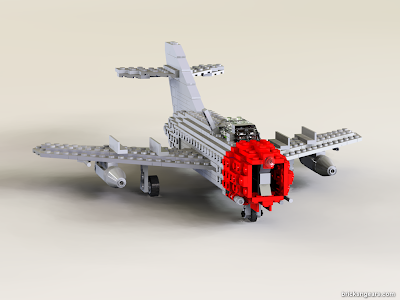
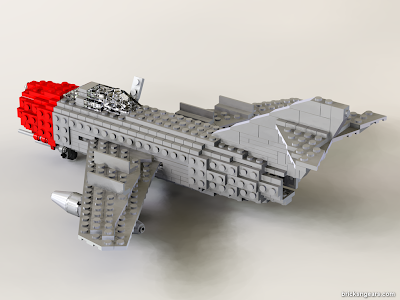
There is a new rendering in the MiG-15 album that shows how the wing is attached to the body:


This render shows the internals of the body, with the outer shell removed. The bricks that are not normally visible are in blue.

The real MiG-15 has a sweep angle of 35 degrees. I approximated that with the typical LEGO Pythagoras layout at 3-4-5 stud offsets. This gives an angle of atan(3/4) = 36.8 degrees.

You can see the triangle at the wing root (large yellow). The studs marked with yellow circles are attached to the body, from the bottom and from the top as well. Even so the structure is far from rigid.

The wing-fences are attached similarly, but the triangle is half the size, at 1.5, 2 and 2.5 stud offsets.

Thursday, June 23, 2011

Silver MiG

I have two piece of news.

First of all, we have the results of the LegoMilitary Build Competition. And I got second prize in the "Warsaw Pact Aircraft" category! I am very happy, I never managed to achieve anything like that in a competition. Mad Physicist was the judge and it was quite competitive... The other finalists are quite impressive too. The An-225 is quite a beast even at 1:100 scale. The Su-9 from John Lamarck is also very nice, for example it has a retractable landing gear. I am proud to be a member of the club.

The second thing is, that of course I was quite curious whether the bricks I have put together on the screen can be actually built together in real life. Executive summary: they can.


In fact the wing was the only place that needed some redesign because the original was incredibly weak. The contour is the same but now it is a little bit stronger. It is not quite like a rock yet, but I am not afraid to hold it in my hands any more. The body is actually quite rigid, it is easy to hold there.

The plane itself is surprisingly heavy. The body consists of many small plates and its interior is quite packed too so that it holds the airplane together. The landing gear is very weak, it can hardly support the vast weight. This can be seen on the photos too. I am still thinking of another design but so far I did not find anything satisfactory.


Also, the rear is quite heavy so I had to put in some extra weight to keep the balance at the front. Inside the plane there are two metal screws that prevent it from "sitting down".

One more thing, the aft of the cabin roof. This is made of a transparent 2x3 slope brick. The last time such a brick was manufactured was in the seventies. I managed to get one, but it is a bit yellowish.


I am happy to have the real plane after all. I have uploaded many photos to the album and of course to Flickr too. One more extra: for hardcore readers I have uploaded the LXF file to this page so that you can try it on Lego Digital Designer.

Sunday, May 15, 2011

MiG-15

Around Easter I have managed to have some rest and even more importantly, away from my other hobbies. As this year's Lego Military Build Competition is currently running I thought I could give it a try.

The announcement of the competition
As I am a big fan of flying things I have tried the "Soviet Cold War Aircraft" category. I chose a MiG-15 as not many LEGO versions exist. The type has served in almost all Warsaw Pact countries including the Hungarian Air Force. Amongst all Soviet types probably this had the most advantage over its Western counterparts. (Does anyone remember Chuck Yeager's Air Combat?)

A Hungarian MiG-15 from the Museum of Hungarian Aviation in Szolnok
Brainstorming has started with the cigar-shaped body. It has a circular cross section with the diameter continuously changing from the front towards the aft. To make it more complicated, the shell gets thin towards the front an the end. The original inspiration was given by the sphere from legohaulic: it seemed that it may be possible to build the cigar from plates, with studs pointing outside.


This is the end result. I tried to build it in the smallest size possible, this corresponds to 1:35 scale approximately. The small size meant some compromises. For example the landing gear is not retractable into the body and the wings.


The model was built with Lego Digital Designerrel in Universe mode). The images were rendered with MegaPOV using Koyan's tutorial. But I already have the bricks underway, I am quite curious if I manage to build it like it is shown on these images.

Until this happens there are more images in the album. Because of the competition I have uploaded the images to Flickr as well.

The competition deadline is May 31st 2011, I am sure we will see lots of great entries.